T206 Honus Wagner CGC Authentic-Restored Die-Cut Wagner sold for $1,337,263
Love Of The Game (Aug 8, 2026)
Lot # 1: 1909-11 T206 Honus Wagner (HOF) - CGC Authentic-Restored - 'The Restored Die-Cut Wagner'
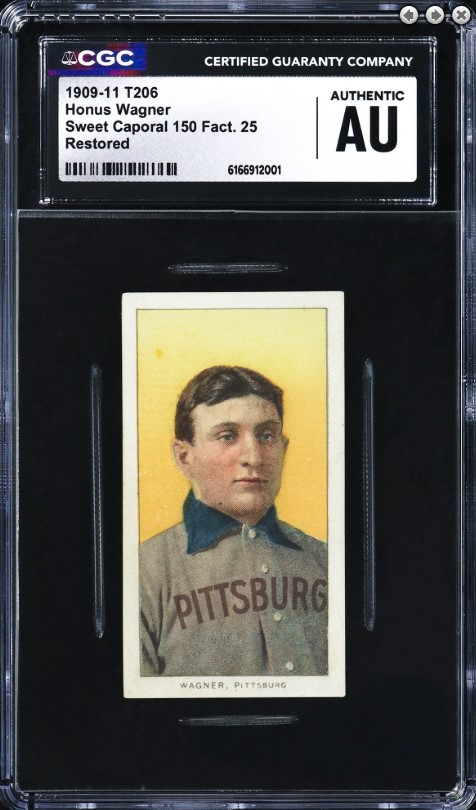
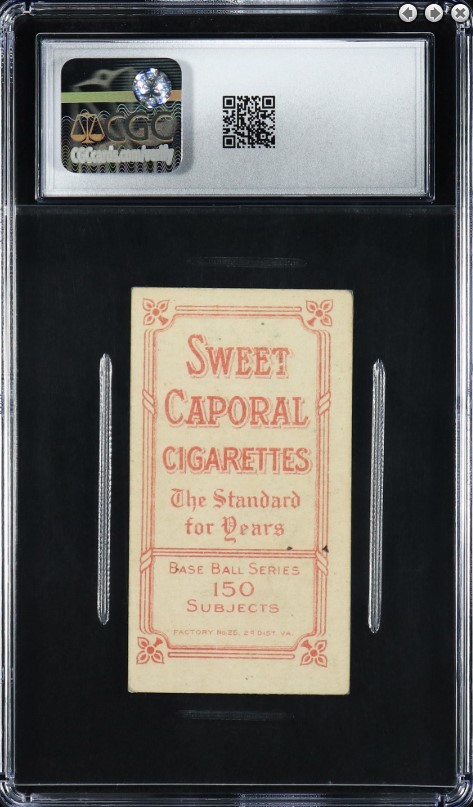
The T206 Honus Wagner is the most important card in our hobby. It is the one every collector knows, the card so many
fantasize about owning but so few have the opportunity or the means to acquire. It carries its own mythology, its own
cadre of scholars, and even its own conspiracy theories. Entire books have been written with the card as their
central subject. This Wagner - the "Restored Die-Cut Wagner" - tells a tale as captivating as the card itself.
Every T206 Wagner has a story. This one is so remarkable, it includes a plot twist. Sold publicly in the 1990s as a
trimmed card that earned the nickname the "Die-Cut Wagner," it would later undergo conservation work so skillful
that even its owner - one of the most sophisticated collectors the hobby has ever known - was uncertain of its
authenticity.
But first, a description of what we see when we examine the card: it is nearly perfect, easily among the three
or four most beautiful T206 Wagners known. Offering immediate, undeniable presence, the familiar bust of Wagner
is centered precisely within the frame, surrounded by four wide white borders. The corners are square and lightly
worn, perhaps EX to EX/MT in appearance, while the background gradually fades from yellow to orange near the
bottom, a characteristic not typically seen on T206 Wagners, but one that reflects the conservation process
discussed later in this description. The reverse bears the familiar Sweet Caporal Factory 25 advertisement,
ever so slightly off-center. A few minor surface blemishes can be observed, nothing dramatic and certainly
nothing that interferes with the tremendous eye appeal of the piece. Only with the benefit of hindsight does one
begin to appreciate what we now know: the card has undergone meticulous, expert conservation that has reclaimed
much of its original beauty while preserving the artifact against further degradation. The result is a presentation
worthy of one of the most instantly recognizable, famous baseball cards in the world.
We have been able to trace the provenance of this card back to a small card shop in a New Jersey shopping mall
in the mid-1970s. The card came into the shop as part of a large collection of T206s, and what made the Wagner
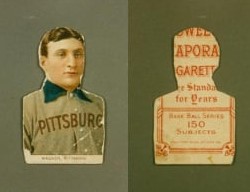
unique and interesting was that the entire background of the card, along with three borders, had been trimmed
away. All that remained was the head and torso that formed the familiar image of Wagner, an illustrated version
of the famous Carl Horner studio portrait that inspired the card. It resembled an H.D. Smith & Company Die-Cut
(the set formerly known as "Scrapps Tobacco") more than a T206.
The shop owners, intrigued by this unusual example of what was, by the mid-1970s, already a famous card, purchased
it for a single dollar. The store's advertisement in a 1976 Sports Collectors Digest offered the card for sale, and
it was eventually purchased by a young Rob Lifson (who later became a great hobby scholar and auctioneer) for the
then-princely sum of $200. Lifson stored the piece in a binder, on top of another T206 to give the illusion of being
a full T206 Wagner, stopping collectors in their tracks whenever they came to that page. "It was a lot of fun to
have and share in this way," Lifson remarks today.
Eventually, Lifson sold the card to his friend and fellow collector Richard Gelman, son of former Topps Art Director
Woody Gelman, for $500. The "Die-Cut" Wagner remained in Gelman's collection until the mid-1990s, when it was
consigned to auction and sold for nearly $10,000. Like Lifson, Gelman purchased the card purely out of the joy
of collecting and the pleasure of owning such a distinctive piece of history, with neither man expecting a profit.
Both were, therefore, thrilled with the auction result.
And then it disappeared.
In the late 1990s, Keith Olbermann, the accomplished collector and award-winning sports anchor, became aware of
some of the expert work being done on sports cards and memorabilia by paper conservators. Out of curiosity and
interest in the possibilities, Olbermann sent a card to be restored and, upon seeing the result, was astonished
by the conservator's capabilities and by what they might mean to the hobby.
Olbermann suggested that they rehabilitate a more high-profile card and then reveal the results to the collecting
community, publicly bringing the issue of ethical card restoration to the forefront. The conservator advised that
he had access to the perfect candidate - a T206 Wagner. Olbermann agreed, contracted with the conservator, and waited.
Some time later, he received a T206 Wagner - perfectly centered, with wide borders, square corners, a gradient
sunset background, and a slightly off-center Sweet Caporal back. Having never seen the original "Die-Cut" Wagner,
Olbermann became skeptical: the card looked too good. Was it authentic? Was the conservator being forthright? And
if so, how should it be presented to the collecting community? To clarify his reservations, he reached out to the
conservator and found he had disappeared. Like a ghost. He moved, left no forwarding address, phone number disconnected.
The conservator gone, Olbermann's questions were left unanswered, and while he mulled it over, he kept the Wagner
on his desk - at best, an expertly restored T206 Wagner, at worst, a costly lesson, and either way, a very
expensive paperweight. Meanwhile, hobby scholars that track the whereabouts of the known examples of T206 Wagners
wondered: "Whatever happened to the 'Die-Cut Wagner'?"
For three decades, the Wagner hid in plain sight, in one of the hobby's most sophisticated collections, its owner
unaware of its origin and unsure of what he had. Eventually adding another Wagner to his collection, the nature of
the restored example became an afterthought.
Recently, a hobbyist remarked to Olbermann that Olbermann's collection included an expertly restored Wagner.
Initially puzzled, Olbermann suddenly remembered the card sealed inside its Lucite holder. Suspecting it might
be the card to which the hobbyist referred, he contacted both LOTG and Rob Lifson. We obtained high-resolution
images of both the Die-Cut Wagner and the "paperweight" for comparison. Upon careful comparison and examination,
it became clear:
They were the same card.
Having had past experience working with Andy Broome, VP of Grading at CGC, we suggested that he would be an excellent
choice to evaluate the piece. After inspecting the card, he agreed: the "Die-Cut Wagner" was now the "Restored Die-Cut
Wagner," and the mystery of its disappearance had been resolved: for three decades, this Wagner had sat in a Lucite
holder on the desk of one of the hobby's most knowledgeable collectors; the conservation work so masterful it was
difficult to believe.
The restoration work is impressive. Several creases and spots of paper loss on the original "Die-Cut" have been
repaired, and then a donor card was matched to the die-cut to provide its new background. The background is somewhat
more yellow than is typical of most T206 Wagners, a characteristic that relates directly to the restoration process.
Because the restoration utilizes an authentic T206 card, the conservator selected a donor card that could be
completely eclipsed by Wagner's image. The resulting gradient background serves as one of the few readily
identifiable indications of the conservation work. Masterful inpainting smoothed the areas between the original
and its new background and lettering, a very slightly raised surface around the "die-cut" leaving only faint evidence
of its presence. A second donor card provides the authentic Sweet Caporal back. The resulting work earned the assessment
of "Authentic - Restored" from CGC - the first T206 Wagner they have ever graded. It is an incredible card - beautiful,
clean, and with one of the more memorable backstories of any Wagner.
When evaluated against the other known "Authentic" and restored Wagners, there is simply no comparison: this stands
alone. Its extraordinary presentation places it in the uppermost tier of surviving examples.
Professional restoration occupies a unique place within the world of premier collectibles. Museums conserve paintings,
antique automobiles are painstakingly returned to their original appearance, and the restoration of important movie
posters and comic books has long been an accepted and commonplace practice when preserving examples of each medium's
most significant treasures. This T206 Honus Wagner presents a similar question: when an artifact of immense significance
survives in diminished form, should it remain forever defined by its damage, or should expert craftsmanship be
permitted to reveal what time has taken away?
Here, the answer is evident. The work was executed with such exceptional skill that it transformed a heavily compromised
survivor into a card capable of once again conveying the visual impact that has made the T206 Wagner the hobby's
ultimate showpiece. Far from diminishing the card's narrative, the restoration has become an integral chapter of it.
Regardless of what appears on the grading label, this is a T206 Wagner that commands immediate attention. Visually,
it rivals all but the handful of truly elite specimens that have become hobby legends. Few Wagners possess such stunning
eye appeal or match its unforgettable backstory. It is, in every sense, an extraordinary example.
In the century since it left the presses of the American Tobacco Company, this T206 Honus Wagner has endured a journey
unlike that of any other example. It spent years in a drastically changed form, then vanished from public view, reemerged
through a restoration of exceptional skill, and spent years in plain sight of one of the pastime's most advanced collectors
before its true identity was finally revealed. Today, it stands not only as an example of the hobby's greatest card,
but as a testament to survival and preservation - a card whose remarkable story is ultimately as engrossing as the
treasure itself. We are honored to offer it here: one of the most beautiful, storied, compelling, and yes, controversial
T206 Wagners the collecting world will ever know.
Final Bid with Buyer's Premium (22%): $1,337,263
RELATED ARTICLES:
Auction Info - Media Coverage
Auction Info - I’m Honus, Dammit
Auction Info - Press Release
Auction Info - Restoration Image Archive
Auction Info - The Cigarette Card Craze
Auction Info - The Legend of Honus Wagner
|